
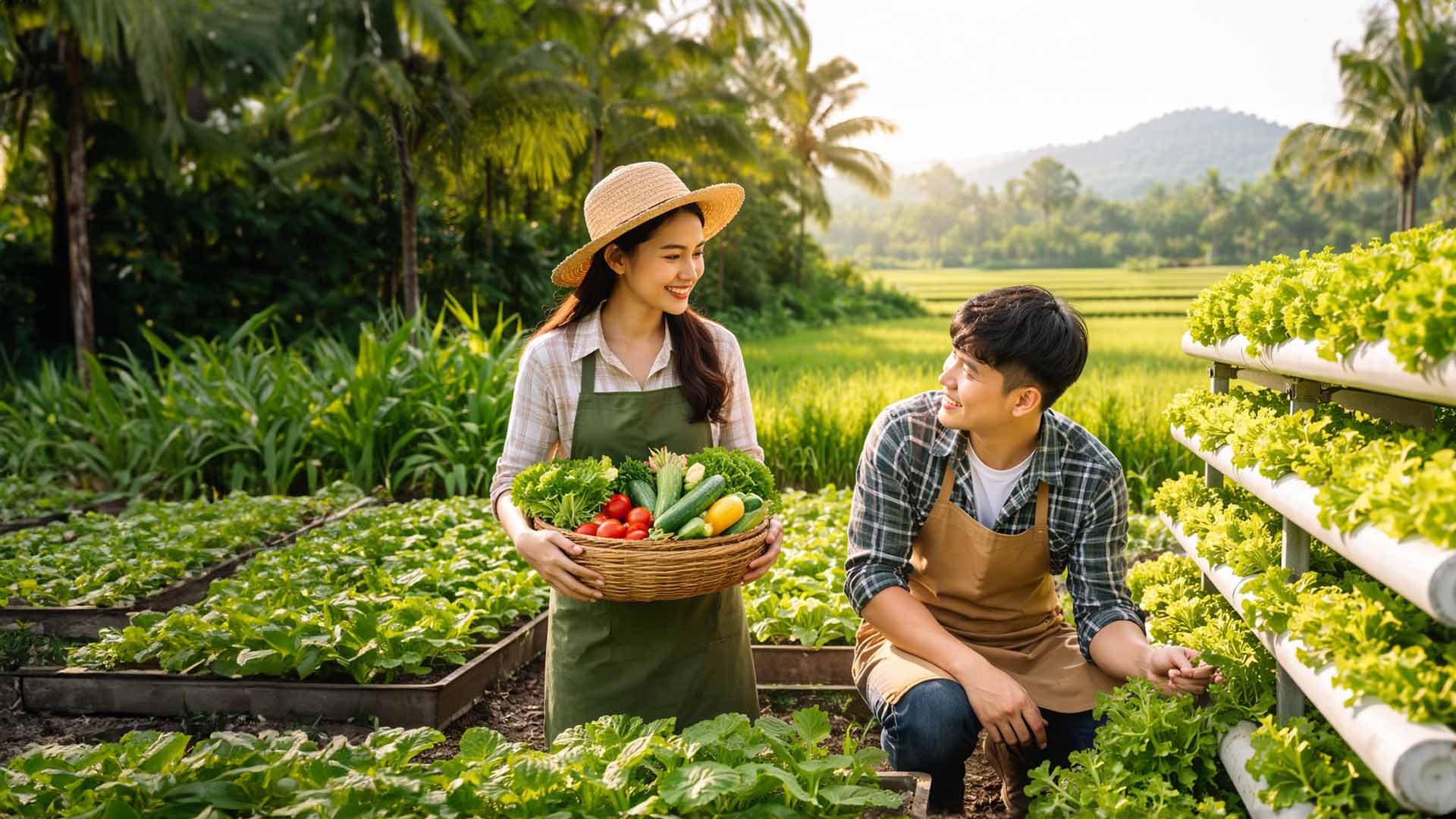
A Paradigm Shift: From Urban Living to Agriculture
Over the past five years, a rarely discussed phenomenon has emerged in Indonesia: a growing wave of urban residents transitioning into agricultural life. This shift is not driven by unemployment, but by a conscious choice toward a more independent, healthier, and economically resilient lifestyle.
Integrated survey data indicates that between 2020 and 2024, the number of new farmers—particularly those without traditional farming backgrounds—has increased significantly. According to reports from Statistics Indonesia (BPS) and the Ministry of Agriculture, participation among beginner farmers aged 25–40 has risen by double-digit percentages compared to the previous decade.
For many young professionals, agriculture is no longer a side activity. It represents an economic migration from urban to rural areas—investing in small plots of land, cultivating organic vegetables, producing specialty export commodities such as coffee, and even developing agro-tourism ventures.
Key Drivers Behind This Trend
Urban Economic Uncertainty
Rising living costs and unstable career paths—especially within contract-based and gig economies—have encouraged many individuals to reassess agriculture as a viable alternative. Farming offers greater control over food production and the potential for recurring income streams.
Health and Environmental Awareness
Consumer demand for locally sourced and organic products continues to grow. Urban farming and hydroponic systems are expanding in major cities such as Jakarta, Bandung, and Surabaya, reflecting broader lifestyle shifts toward sustainability.
Technology and Information Access
Digital platforms, agritech solutions, and online farming communities have made modern agricultural practices more accessible. New farmers can now adopt precision farming methods, hydroponics, and data-driven cultivation without relying solely on traditional knowledge.
Government Support and Financing
Government programs offering credit schemes, training initiatives, and simplified certification processes have lowered entry barriers. These incentives make agriculture increasingly feasible for young entrepreneurs and first-generation farmers.
Notable Recent Insights
-
The proportion of farmers under 40 has steadily increased since 2020.
-
Small- and medium-scale horticulture (vegetables and fruits) has grown faster than staple crop production.
-
Urban farming communities and digital marketplaces have expanded distribution channels for local produce.
(Data compiled from annual reports by BPS, the Ministry of Agriculture, and agritech industry publications from 2020–2024.)
Shifting Commodity Patterns
Indonesian agriculture now extends far beyond rice and corn production. Emerging and high-value commodities include:
-
Specialty Indonesian coffee, now competing in premium global markets.
-
Palm oil and rubber, remaining major export contributors while facing sustainability reforms.
-
Horticulture and organic vegetables, increasingly favored in domestic markets due to health trends.
-
Agro-tourism and agricultural education, becoming attractive business models for younger generations.
Conclusion
Agriculture in Indonesia is no longer solely about food production—it reflects a broader social transformation and emerging economic opportunity. The urban-to-rural shift, growth of young farmers, integration of agritech, and expansion of export-driven commodities position the sector as increasingly relevant not only for traditional farmers, but also for startups, investors, and individuals seeking a more sustainable and productive way of life.


 No products in the cart.